
Less but Better
I just learned that the idea for Deeponomics is aligned with Essentialism.

I just finished reading Essentialism, the Disciplined Pursuit of Less by Greg McKeown. I know I am a bit late on the ball. The book was first published in 2014, and has since gathered a large following, or recruits, or acolytes. People who follow or try to live the life of an Essentialist. At least that’s what I’ve heard. I’ve never met one myself.
This is not a book review, so If you are interested in learning the concept of Essentialism, buy the book and support the author. It’s great. It really is.
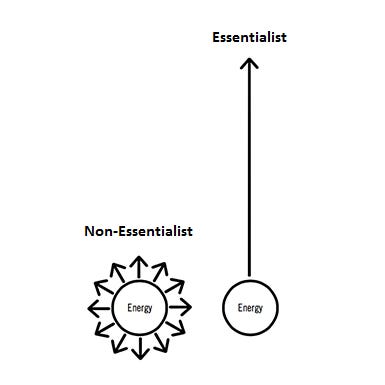
But what did occur to me as I was reading it was that many of the books’ theories, or ideas I’ve had myself. Unformulated and unspoken. And look, I am by no means trying to steal the thunder here, I am not a great thinker and author like Greg. But what I mean is so much resonated with me, and without me knowing it until having read the book, I already, in many ways, practice the life of a Essentialist.
And I think all of us, when reading a book about how to change ones life for the better, as you read the book the focus is on yourself. Every concept, idea, metaphor being used you convert it into your life. At least that is what I did. And as I was reading, I was like “Yes, exactly, that’s what I have been saying for years” or you know, something like that.
Deeponomics to me entails the principles of Essentialism, less but better. It is all about subtracting a lot of non-essentials (as Greg calls it) from your life. For me it’s been a compounding process, step by step, over the most recent two to three years, of exclusion (deciding about what it’s not even a thing to consider for a Yes or No. For example, me buying a PlayStation or starting to watch football all of sudden), subtraction (taking out something you’ve said yes to earlier; so Yes before, No now) and non-addition (what I simply call saying No to new opportunities).
In addition to being mindful and highly selective of activities, I have done the same with people. And yeah, I will not win any popularity contests anytime soon, but I respect myself and my choices more and more everyday. I believe people close to me are starting to grasp it as well and are beginning to respect me more, even though they might like me less. And I will choose respect over being liked every time, every times, every of the times…
When asking yourself the question, “Is this really essential?”, it becomes so easy saying no. That is, if you already know what is essential for you. I just found out what is essential for me. My goal is to live a life of simplicity, that entails high contribution and meaning. Words used by Greg in the book. And my essential intent, let us call it my strategy for life, is concrete and inspirational.
Through design and not default, by editing vigorously, saying a lot of no and one Hell Yeah, creating clarity, and having a concrete and inspirational essential intent, less but better opportunities which are aligned with my long-term goal have emerged. Deeponomics is one of those projects I have decided to devote my time to. It will grow, and change, I will make mistakes and hopefully learn, and I will iterate, and at some point further down the line, it will get better, I will get better. But since I lead a life of an Essentialist, I lead a life without regret.
Let us end this post with how Greg ends the book:
“The life of an Essentialist is a life lived without regret. If you have correctly identified what really matters, if you invest your time and energy in it, then it is difficult to regret the choices you make. You become proud of the life you have chosen to live”.
References
McKeown, G. (2014). Essentialism: The Disciplined Pursuit of Less. New York: Crown Business.